Boost
C++ Libraries
Boost
C++ Libraries
...one of the most highly
regarded and expertly designed C++ library projects in the
world.
— Herb Sutter and Andrei
Alexandrescu, C++
Coding Standards
Boost
C++ Libraries
...one of the most highly
regarded and expertly designed C++ library projects in the
world.
— Herb Sutter and Andrei
Alexandrescu, C++
Coding Standards

adjacency_matrix<Directed, VertexProperty,
                 EdgeProperty, GraphProperty,
                 Allocator>
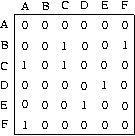
  enum { A, B, C, D, E, F, N };
  const char* name = "ABCDEF";

  typedef boost::adjacency_matrix<boost::directedS> Graph;
  Graph g(N);
  add_edge(B, C, g);
  add_edge(B, F, g);
  add_edge(C, A, g);
  add_edge(C, C, g);
  add_edge(D, E, g);
  add_edge(E, D, g);
  add_edge(F, A, g);

  std::cout << "vertex set: ";
  boost::print_vertices(g, name);
  std::cout << std::endl;

  std::cout << "edge set: ";
  boost::print_edges(g, name);
  std::cout << std::endl;

  std::cout << "out-edges: " << std::endl;
  boost::print_graph(g, name);
  std::cout << std::endl;
The output is:
  vertex set: A B C D E F

  edge set: (B,C) (B,F) (C,A) (C,C) (D,E) (E,D) (F,A)

  out-edges:
  A -->
  B --> C F
  C --> A C
  D --> E
  E --> D
  F --> A
Creating the graph of Figure 2.
  enum { A, B, C, D, E, F, N };
  const char* name = "ABCDEF";

  typedef boost::adjacency_matrix<boost::undirectedS> UGraph;
  UGraph ug(N);
  add_edge(B, C, ug);
  add_edge(B, F, ug);
  add_edge(C, A, ug);
  add_edge(D, E, ug);
  add_edge(F, A, ug);

  std::cout << "vertex set: ";
  boost::print_vertices(ug, name);
  std::cout << std::endl;

  std::cout << "edge set: ";
  boost::print_edges(ug, name);
  std::cout << std::endl;

  std::cout << "incident edges: " << std::endl;
  boost::print_graph(ug, name);
  std::cout << std::endl;
The output is:
  vertex set: A B C D E F

  edge set: (C,A) (C,B) (E,D) (F,A) (F,B)

  incident edges:
  A <--> C F
  B <--> C F
  C <--> A B
  D <--> E
  E <--> D
  F <--> A B
| Parameter | Description | Default |
|---|---|---|
| Directed | A selector to choose whether the graph is directed or undirected. The options are directedS and undirectedS. | directedS |
| VertexProperty | for specifying internal property storage. | no_property |
| EdgeProperty | for specifying internal property storage. | no_property |
| GraphProperty | for specifying property storage for the graph object. | no_property |
adjacency_matrix(vertices_size_type n,
                 const GraphProperty& p = GraphProperty())
Creates a graph object with n vertices and zero edges.
template <typename EdgeIterator>
adjacency_matrix(EdgeIterator first,
                 EdgeIterator last,
                 vertices_size_type n,
                 const GraphProperty& p = GraphProperty())
Creates a graph object with n vertices with the edges
specified in the edge list given by the range [first, last).
The value type of the EdgeIterator must be a
std::pair, where the type in the pair is an integer type. The
integers will correspond to vertices, and they must all fall in the
range of
[0, n).
template <typename EdgeIterator, typename EdgePropertyIterator>
adjacency_matrix(EdgeIterator first, EdgeIterator last,
                 EdgePropertyIterator ep_iter,
                 vertices_size_type n,
                 const GraphProperty& p = GraphProperty())
Creates a graph object with n vertices, with the edges
specified in the edge list given by the range [first, last).
The value type of the EdgeIterator must be a
std::pair, where the type in the pair is an integer type. The
integers will correspond to vertices, and they must all fall in the
range of [0, n). The value_type of the
ep_iter should be EdgeProperty.
std::pair<vertex_iterator, vertex_iterator>
vertices(const adjacency_matrix& g)
Returns an iterator-range providing access to the vertex set of graph g.
std::pair<edge_iterator, edge_iterator>
edges(const adjacency_matrix& g)
Returns an iterator-range providing access to the edge set of graph g.
std::pair<adjacency_iterator, adjacency_iterator>
adjacent_vertices(vertex_descriptor v, const adjacency_matrix& g)
Returns an iterator-range providing access to the vertices adjacent to vertex v in graph g.
std::pair<out_edge_iterator, out_edge_iterator>
out_edges(vertex_descriptor v, const adjacency_matrix& g)
Returns an iterator-range providing access to the out-edges of vertex v in graph g. If the graph is undirected, this iterator-range provides access to all edge incident on vertex v.
vertex_descriptor
source(edge_descriptor e, const adjacency_matrix& g)
Returns the source vertex of edge e.
vertex_descriptor
target(edge_descriptor e, const adjacency_matrix& g)
Returns the target vertex of edge e.
degree_size_type
out_degree(vertex_descriptor u, const adjacency_matrix& g)
Returns the number of edges leaving vertex u.
vertices_size_type num_vertices(const adjacency_matrix& g)Returns the number of vertices in the graph g.
edges_size_type num_edges(const adjacency_matrix& g)Returns the number of edges in the graph g.
vertex_descriptor vertex(vertices_size_type n, const adjacency_matrix& g)Returns the nth vertex in the graph's vertex list.
std::pair<edge_descriptor, bool>
edge(vertex_descriptor u, vertex_descriptor v,
     const adjacency_matrix& g)
Returns the edge connecting vertex u to vertex v in graph g.
std::pair<edge_descriptor, bool>
add_edge(vertex_descriptor u, vertex_descriptor v,
         adjacency_matrix& g)
Adds edge (u,v) to the graph and returns the edge descriptor for
the new edge. If the edge is already in the graph then a duplicate
will not be added and the bool flag will be false.
This operation does not invalidate any of the graph's iterators
or descriptors.
std::pair<edge_descriptor, bool>
add_edge(vertex_descriptor u, vertex_descriptor v,
         const EdgeProperty& p,
         adjacency_matrix& g)
Adds edge (u,v) to the graph and attaches p as the
value of the edge's internal property storage. Also see the previous
add_edge() member function for more details.
void remove_edge(vertex_descriptor u, vertex_descriptor v,
                 adjacency_matrix& g)
Removes the edge (u,v) from the graph. void remove_edge(edge_descriptor e, adjacency_matrix& g)Removes the edge e from the graph. This is equivalent to calling remove_edge(source(e, g), target(e, g), g).
void clear_vertex(vertex_descriptor u, adjacency_matrix& g)Removes all edges to and from vertex u. The vertex still appears in the vertex set of the graph.
template <typename Property>
property_map<adjacency_matrix, Property>::type
get(Property, adjacency_matrix& g)

template <typename Property>
property_map<adjacency_matrix, Property>::const_type
get(Property, const adjacency_matrix& g)
Returns the property map object for the vertex property specified by Property. The Property must match one of the properties specified in the graph's VertexProperty template argument.
template <typename Property, typename X>
typename property_traits<
  typenamae property_map<adjacency_matrix, Property>::const_type
>::value_type
get(Property, const adjacency_matrix& g, X x)
This returns the property value for x, which is either a vertex or edge descriptor.
template <typename Property, typename X, typename Value>
void
put(Property, const adjacency_matrix& g, X x, const Value& value)
This sets the property value for x to value. x is either a vertex or edge descriptor. Value must be convertible to typename property_traits<property_map<adjacency_matrix, Property>::type>::value_type.
template <typename GraphProperty, typename GraphProperty>
typename property_value<GraphProperty, GraphProperty>::type&
get_property(adjacency_matrix& g, GraphProperty)
Return the property specified by GraphProperty that is attached to the graph object g. The property_value traits class is defined in boost/pending/property.hpp.
template <typename GraphProperty, typename GraphProperty>
const typename property_value<GraphProperty, GraphProperty>::type&
get_property(const adjacency_matrix& g, GraphProperty)
Return the property specified by GraphProperty that is attached to the graph object g. The property_value traits class is defined in boost/pending/property.hpp.