#include <boost/math/optimization/nesterov.hpp>
namespace boost {
namespace math {
namespace optimization {
namespace rdiff = boost::math::differentiation::reverse_mode;
template<typename ArgumentContainer,
typename RealType,
class Objective,
class InitializationPolicy,
class ObjectiveEvalPolicy,
class GradEvalPolicy>
class nesterov_accelerated_gradient
: public abstract_optimizer<
ArgumentContainer,
RealType,
Objective,
InitializationPolicy,
ObjectiveEvalPolicy,
GradEvalPolicy,
nesterov_update_policy<RealType>,
nesterov_accelerated_gradient<ArgumentContainer,
RealType,
Objective,
InitializationPolicy,
ObjectiveEvalPolicy,
GradEvalPolicy>>
{
public:
nesterov_accelerated_gradient(Objective&& objective,
ArgumentContainer& x,
InitializationPolicy&& ip,
ObjectiveEvalPolicy&& oep,
GradEvalPolicy&& gep,
nesterov_update_policy<RealType>&& up);
void step();
};
template<class Objective, typename ArgumentContainer, typename RealType>
auto make_nag(Objective&& obj,
ArgumentContainer& x,
RealType lr = RealType{ 0.01 },
RealType mu = RealType{ 0.95 });
template<class Objective,
typename ArgumentContainer,
typename RealType,
class InitializationPolicy>
auto make_nag(Objective&& obj,
ArgumentContainer& x,
RealType lr,
RealType mu,
InitializationPolicy&& ip);
template<typename ArgumentContainer,
typename RealType,
class Objective,
class InitializationPolicy,
class ObjectiveEvalPolicy,
class GradEvalPolicy>
auto make_nag(Objective&& obj,
ArgumentContainer& x,
RealType lr,
RealType mu,
InitializationPolicy&& ip,
ObjectiveEvalPolicy&& oep,
GradEvalPolicy&& gep);
}
}
}
Nesterov accelerated gradient (NAG) is a first-order optimizer that augments
gradient descent with a momentum term and evaluates the gradient at a "lookahead"
point. In practice this often improves convergence speed compared to vanilla
gradient descent, especially in narrow valleys and ill-conditioned problems.
NAG maintains a "velocity" vector v (same shape as x). At iteration
k it performs:
v = mu * v - lr * g;
x += -mu * v_prev + (1 + mu) *v
where:
lr is the learning rate / step size
mu is the momentum coefficient (typically close to 1)
Setting mu = 0 reduces NAG to standard gradient descent.
-
Objective&&
obj
: objective function to
minimize.
-
ArgumentContainer&
x
: variables to optimize over.
Updated in place.
-
RealType lr
: learning rate. Larger values take larger steps (faster but potentially
unstable). Smaller values are more stable but converge more slowly.
-
RealType mu
: momentum coefficient in [0,1). Higher values, e.g. 0.9 to 0.99, typically
accelerate convergence but may require a smaller lr
-
InitializationPolicy&& ip
: Initialization policy for optimizer state and variables. Users may
supply a custom initialization policy to control how the argument container
and any AD-specific runtime state : i.e. reverse-mode tape attachment/reset
are initialized. By default, the optimizer uses the same initialization
as gradient descent, taking the user provided initial values in x and
initializing the internal momentum/velocity state to zero. Custom initialization
policies are useful for randomized starts, non rvar AD types, or when
gradients are supplied externally. Check the docs for Reverse Mode autodiff
policies for initialization policy structure to write custom policies.
-
ObjectiveEvalPolicy&&
oep
: objective evaluation
policy. By default reverse_mode_function_eval_policy<RealType>
-
GradEvalPolicy&&
gep
: gradient evaluation policy.
By default reverse_mode_gradient_evaluation_policy<RealType>
-
NAG uses the same policy-based design as gradient descent: initialization,
objective evaluation, and gradient evaluation can be customized independently.
-
When using reverse-mode AD
rvar,
the objective should be written in terms of AD variables so gradients
can be obtained automatically by the default gradient evaluation policy.
-
Typical tuning: start with
mu
= 0.9
or 0.95; if the objective
oscillates or diverges, reduce lr
(or slightly reduce mu).
#include <boost/math/differentiation/autodiff_reverse.hpp>
#include <boost/math/optimization/gradient_descent.hpp>
#include <boost/math/optimization/minimizer.hpp>
#include <cmath>
#include <fstream>
#include <iostream>
#include <random>
#include <string>
namespace rdiff = boost::math::differentiation::reverse_mode;
namespace bopt = boost::math::optimization;
double random_double(double min = 0.0, double max = 1.0)
{
static thread_local std::mt19937 rng{std::random_device{}()};
std::uniform_real_distribution<double> dist(min, max);
return dist(rng);
}
template<typename S>
struct vec3
{
S x, y, z;
};
template<class S>
static inline vec3<S> sph_to_xyz(const S& theta, const S& phi)
{
return {sin(theta) * cos(phi), sin(theta) * sin(phi), cos(theta)};
}
template<typename T>
T thomson_energy(std::vector<T>& r)
{
const size_t N = r.size() / 2;
const T tiny = T(1e-12);
T E = 0;
for (size_t i = 0; i < N; ++i) {
const T& theta_i = r[2 * i + 0];
const T& phi_i = r[2 * i + 1];
auto ri = sph_to_xyz(theta_i, phi_i);
for (size_t j = i + 1; j < N; ++j) {
const T& theta_j = r[2 * j + 0];
const T& phi_j = r[2 * j + 1];
auto rj = sph_to_xyz(theta_j, phi_j);
T dx = ri.x - rj.x;
T dy = ri.y - rj.y;
T dz = ri.z - rj.z;
T d2 = dx * dx + dy * dy + dz * dz + tiny;
E += 1.0 / sqrt(d2);
}
}
return E;
}
template<class T>
std::vector<rdiff::rvar<T, 1>> init_theta_phi_uniform(size_t N, unsigned seed = 12345)
{
const T pi = T(3.1415926535897932384626433832795);
std::mt19937 rng(seed);
std::uniform_real_distribution<T> unif01(T(0), T(1));
std::uniform_real_distribution<T> unifm11(T(-1), T(1));
std::vector<rdiff::rvar<T, 1>> u;
u.reserve(2 * N);
for (size_t i = 0; i < N; ++i) {
T z = unifm11(rng);
T phi = (T(2) * pi) * unif01(rng) - pi;
T theta = std::acos(z);
u.emplace_back(theta);
u.emplace_back(phi);
}
return u;
}
int main(int argc, char* argv[])
{
if (argc != 2) {
std::cerr << "Usage: " << argv[0] << " <N>\n";
return 1;
}
const int N = std::stoi(argv[1]);
const double lr = 1e-3;
const double mu = 0.95;
auto u_ad = init_theta_phi_uniform<double>(N);
auto nesterov_opt = bopt::make_nag(&thomson_energy<rdiff::rvar<double, 1>>, u_ad, lr, mu);
std::string pos_filename = "thomson_" + std::to_string(N) + ".csv";
std::string energy_filename = "nesterov_energy_" + std::to_string(N) + ".csv";
std::ofstream pos_out(pos_filename);
std::ofstream energy_out(energy_filename);
energy_out << "step,energy\n";
auto result = minimize(nesterov_opt);
for (int pi = 0; pi < N; ++pi) {
double theta = u_ad[2 * pi + 0].item();
double phi = u_ad[2 * pi + 1].item();
auto r = sph_to_xyz(theta, phi);
pos_out << pi << "," << r.x << "," << r.y << "," << r.z << "\n";
}
auto E = nesterov_opt.objective_value();
int i = 0;
for(auto& obj_hist : result.objective_history)
{
energy_out << i << "," << obj_hist << "\n";
++i;
}
energy_out << "," << E << "\n";
pos_out.close();
energy_out.close();
return 0;
}
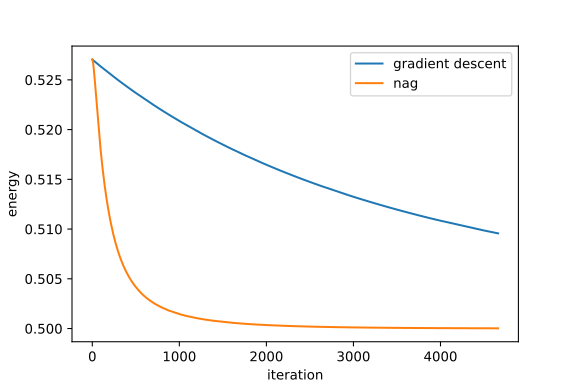
The nesterov version of this problem converges much faster than regular gradient
descent, in only 4663 iterations
with default parameters, vs the 93799
iterations required by gradient descent.
 Boost
C++ Libraries
Boost
C++ Libraries