#include <boost/math/tools/roots.hpp>
namespace boost { namespace math {
namespace tools {
template <class F, class T>
BOOST_MATH_GPU_ENABLED T newton_raphson_iterate(F f, T guess, T min, T max, int digits);
template <class F, class T>
BOOST_MATH_GPU_ENABLED T newton_raphson_iterate(F f, T guess, T min, T max, int digits, std::uintmax_t& max_iter);
template <class F, class T>
T halley_iterate(F f, T guess, T min, T max, int digits);
template <class F, class T>
T halley_iterate(F f, T guess, T min, T max, int digits, std::uintmax_t& max_iter);
template <class F, class T>
T schroder_iterate(F f, T guess, T min, T max, int digits);
template <class F, class T>
T schroder_iterate(F f, T guess, T min, T max, int digits, std::uintmax_t& max_iter);
template <class F, class ComplexType>
Complex complex_newton(F f, Complex guess, int max_iterations = std::numeric_limits<typename ComplexType::value_type>::digits);
template<class T>
auto quadratic_roots(T const & a, T const & b, T const & c);
}}}
These functions all perform iterative root-finding using
derivatives:
-
newton_raphson_iterate
performs second-order Newton-Raphson
iteration.
-
halley_iterate and schroder_iterate perform third-order
Halley and Schröder iteration.
-
complex_newton performs
Newton's method on complex-analytic functions.
-
solve_quadratic solves
quadratic equations using various tricks to keep catastrophic cancellation
from occurring in computation of the discriminant.
Parameters of the real-valued root finding functions
- F f
-
Type F must be a callable function object (or C++ lambda) that accepts
one parameter and returns a std::pair,
std::tuple, boost::tuple or boost::fusion::tuple:
For second-order iterative method (Newton
Raphson) the tuple
should have two elements containing
the evaluation of the function and its first derivative.
For the third-order methods (Halley
and Schroeder) the tuple
should have three elements containing
the evaluation of the function and its first and second derivatives.
- T guess
The initial starting value. A good guess is crucial to quick convergence!
- T min
The minimum possible value for the result, this is used as an initial
lower bracket.
- T max
The maximum possible value for the result, this is used as an initial
upper bracket.
- int digits
The desired number of binary digits precision.
- uintmax_t& max_iter
An optional maximum number of iterations to perform. On exit, this is
updated to the actual number of iterations performed.
When using these functions you should note that:
-
Default
max_iter =
(std::numeric_limits<std::uintmax_t>::max)()
is effectively 'iterate for ever'.
-
They may be very sensitive to the initial guess, typically they converge
very rapidly if the initial guess has two or three decimal digits correct.
However convergence can be no better than bisect,
or in some rare cases, even worse than bisect
if the initial guess is a long way from the correct value and the derivatives
are close to zero.
-
These functions include special cases to handle zero first (and second
where appropriate) derivatives, and fall back to bisect
in this case. However, it is helpful if functor F is defined to return
an arbitrarily small value of the correct sign rather
than zero.
-
The functions will raise an evaluation_error
if arguments
min and max are the wrong way around or if they
converge to a local minima.
-
If the derivative at the current best guess for the result is infinite
(or very close to being infinite) then these functions may terminate prematurely.
A large first derivative leads to a very small next step, triggering the
termination condition. Derivative based iteration may not be appropriate
in such cases.
-
If the function is 'Really Well Behaved' (is monotonic and has only one
root) the bracket bounds min and max
may as well be set to the widest limits like zero and
numeric_limits<T>::max().
-
But if the function more complex and may have more than one root or a pole,
the choice of bounds is protection against jumping out to seek the 'wrong'
root.
-
These functions fall back to bisect
if the next computed step would take the next value out of bounds. The
bounds are updated after each step to ensure this leads to convergence.
However, a good initial guess backed up by asymptotically-tight bounds
will improve performance no end - rather than relying on bisection.
-
The value of digits is crucial to good performance
of these functions, if it is set too high then at best you will get one
extra (unnecessary) iteration, and at worst the last few steps will proceed
by bisection.
Remember that the returned value can never be more accurate than f(x)
can be evaluated, and that if f(x) suffers from cancellation
errors as it tends to zero then the computed steps will be effectively
random. The value of digits should be set so that
iteration terminates before this point: remember that for second and third
order methods the number of correct digits in the result is increasing
quite substantially with each iteration, digits should
be set by experiment so that the final iteration just takes the next value
into the zone where f(x) becomes inaccurate. A good
starting point for digits would be 0.6*D for Newton
and 0.4*D for Halley or Shröder iteration, where D is
std::numeric_limits<T>::digits.
-
If you need some diagnostic output to see what is going on, you can
#define BOOST_MATH_INSTRUMENT
before the #include <boost/math/tools/roots.hpp>, and also ensure that display of all
the significant digits with cout.precision(std::numeric_limits<double>::digits10): or even possibly significant digits with
cout.precision(std::numeric_limits<double>::max_digits10):
but be warned, this may produce copious output!
-
Finally: you may well be able to do better than these functions by hand-coding
the heuristics used so that they are tailored to a specific function. You
may also be able to compute the ratio of derivatives used by these methods
more efficiently than computing the derivatives themselves. As ever, algebraic
simplification can be a big win.
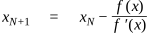
Given an initial guess x0 the subsequent values are computed
using:
Out-of-bounds steps revert to bisection
of the current bounds.
Under ideal conditions, the number of correct digits doubles with each iteration.
Given an initial guess x0 the subsequent values are computed
using:
Over-compensation by the second derivative (one which would proceed in the
wrong direction) causes the method to revert to a Newton-Raphson step.
Out of bounds steps revert to bisection of the current bounds.
Under ideal conditions, the number of correct digits trebles with each iteration.
Given an initial guess x0 the subsequent values are computed using:
Over-compensation by the second derivative (one which would proceed in the
wrong direction) causes the method to revert to a Newton-Raphson step. Likewise
a Newton step is used whenever that Newton step would change the next value
by more than 10%.
Out of bounds steps revert to bisection
of the current bounds.
Under ideal conditions, the number of correct digits trebles with each iteration.
This is Schroeder's general result (equation 18 from Stewart,
G. W. "On Infinitely Many Algorithms for Solving Equations." English
translation of Schroeder's original paper. College Park, MD: University of
Maryland, Institute for Advanced Computer Studies, Department of Computer Science,
1993.)
This method guarantees at least quadratic convergence (the same as Newton's
method), and is known to work well in the presence of multiple roots: something
that neither Newton nor Halley can do.
The complex Newton method works slightly differently than the rest of the methods:
Since there is no way to bracket roots in the complex plane, the min and max
arguments are not accepted. Failure to reach a root is communicated by returning
nans. Remember that if a function
has many roots, then which root the complex Newton's method converges to is
essentially impossible to predict a priori; see the Newton's fractal for more
information.
Finally, the derivative of f must be continuous at the
root or else non-roots can be found; see here
for an example.
An example usage of complex_newton
is given in examples/daubechies_coefficients.cpp.
To solve a quadratic ax2 + bx + c
= 0, we may use
auto [x0, x1] = boost::math::tools::quadratic_roots(a, b, c);
If the roots are real, they are arranged so that x0
≤ x1. If the roots are
complex and the inputs are real, x0
and x1 are both std::numeric_limits<Real>::quiet_NaN(). In this case we must cast a, b
and c to a complex type to
extract the complex roots. If a,
b and c
are integral, then the roots are of type double. The routine is much faster
if the fused-multiply-add instruction is available on your architecture. If
the fma is not available, the function resorts to slow emulation. Finally,
speed is improved if you compile for your particular architecture. For instance,
if you compile without any architecture flags, then the std::fma call
compiles down to call _fma,
which dynamically chooses to emulate or execute the vfmadd132sd
instruction based on the capabilities of the architecture. If instead, you
compile with (say) -march=native then
no dynamic choice is made: The vfmadd132sd
instruction is always executed if available and emulation is used if not.
See root-finding examples.
 Boost
C++ Libraries
Boost
C++ Libraries