#include <boost/math/tools/roots.hpp>
namespace boost{ namespace math{
namespace tools{
template <class F, class T>
T newton_raphson_iterate(F f, T guess, T min, T max, int digits);
template <class F, class T>
T newton_raphson_iterate(F f, T guess, T min, T max, int digits, boost::uintmax_t& max_iter);
template <class F, class T>
T halley_iterate(F f, T guess, T min, T max, int digits);
template <class F, class T>
T halley_iterate(F f, T guess, T min, T max, int digits, boost::uintmax_t& max_iter);
template <class F, class T>
T schroeder_iterate(F f, T guess, T min, T max, int digits);
template <class F, class T>
T schroeder_iterate(F f, T guess, T min, T max, int digits, boost::uintmax_t& max_iter);
}}}
These functions all perform iterative root finding using derivatives:
The functions all take the same parameters:
Parameters of the root finding functions
- F f
-
Type F must be a callable function object that accepts one parameter
and returns a boost::math::tuple:
For the second order iterative methods (Newton
Raphson) the boost::math::tuple
should have two elements containing
the evaluation of the function and its first derivative.
For the third order methods (Halley
and Schroeder) the boost::math::tuple
should have three elements containing
the evaluation of the function and its first and second derivatives.
- T guess
The initial starting value. A good guess is crucial to quick convergence!
- T min
The minimum possible value for the result, this is used as an initial
lower bracket.
- T max
The maximum possible value for the result, this is used as an initial
upper bracket.
- int digits
The desired number of binary digits.
- uintmax_t& max_iter
An optional maximum number of iterations to perform. On exit this is
set to the actual number of iterations performed.
When using these functions you should note that:
-
Default max_iter =
(std::numeric_limits<boost::uintmax_t>::max)() is effectively 'iterate for ever'!.
-
They may be very sensitive to the initial guess, typically they converge
very rapidly if the initial guess has two or three decimal digits correct.
However convergence can be no better than bisection, or in some rare
cases, even worse than bisection if the initial guess is a long way from
the correct value and the derivatives are close to zero.
-
These functions include special cases to handle zero first (and second
where appropriate) derivatives, and fall back to bisection in this case.
However, it is helpful if functor F is defined to return an arbitrarily
small value of the correct sign rather than zero.
-
If the derivative at the current best guess for the result is infinite
(or very close to being infinite) then these functions may terminate
prematurely. A large first derivative leads to a very small next step,
triggering the termination condition. Derivative based iteration may
not be appropriate in such cases.
-
If the function is 'Really Well Behaved' (monotonic and has only one
root) the bracket bounds min and max may as well be set to the widest
limits like zero and
numeric_limits<T>::max().
-
But if the function more complex and may have more than one root or a
pole, the choice of bounds is protection against jumping out to seek
the 'wrong' root.
-
These functions fall back to bisection if the next computed step would
take the next value out of bounds. The bounds are updated after each
step to ensure this leads to convergence. However, a good initial guess
backed up by asymptotically-tight bounds will improve performance no
end - rather than relying on bisection.
-
The value of digits is crucial to good performance
of these functions, if it is set too high then at best you will get one
extra (unnecessary) iteration, and at worst the last few steps will proceed
by bisection. Remember that the returned value can never be more accurate
than f(x) can be evaluated, and that if f(x) suffers from cancellation
errors as it tends to zero then the computed steps will be effectively
random. The value of digits should be set so that
iteration terminates before this point: remember that for second and
third order methods the number of correct digits in the result is increasing
quite substantially with each iteration, digits
should be set by experiment so that the final iteration just takes the
next value into the zone where f(x) becomes inaccurate.
-
To get the binary digits of accuracy, use policies::get_max_root_iterations<Policy>()).
-
If you need some diagnostic output to see what is going on, you can
#define BOOST_MATH_INSTRUMENT
before the #include <boost/math/tools/roots.hpp>, and also ensure that display of
all the possibly significant digits with cout.precision(std::numeric_limits<double>::max_digits10): but be warned, this may produce copious
output!
-
Finally: you may well be able to do better than these functions by hand-coding
the heuristics used so that they are tailored to a specific function.
You may also be able to compute the ratio of derivatives used by these
methods more efficiently than computing the derivatives themselves. As
ever, algebraic simplification can be a big win.
Given an initial guess x0 the subsequent values are computed using:

Out of bounds steps revert to bisection of the current bounds.
Under ideal conditions, the number of correct digits doubles with each iteration.
Given an initial guess x0 the subsequent values are computed using:

Over-compensation by the second derivative (one which would proceed in the
wrong direction) causes the method to revert to a Newton-Raphson step.
Out of bounds steps revert to bisection of the current bounds.
Under ideal conditions, the number of correct digits trebles with each iteration.
Given an initial guess x0 the subsequent values are computed using:

Over-compensation by the second derivative (one which would proceed in the
wrong direction) causes the method to revert to a Newton-Raphson step. Likewise
a Newton step is used whenever that Newton step would change the next value
by more than 10%.
Out of bounds steps revert to bisection of the current bounds.
Under ideal conditions, the number of correct digits trebles with each iteration.
Let's suppose we want to find the cube root of a number: the equation we
want to solve along with its derivatives are:
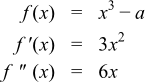
To begin with lets solve the problem using Newton-Raphson iterations, we'll
begin by defining a function object (functor) that returns the evaluation
of the function to solve, along with its first derivative f'(x):
template <class T>
struct cbrt_functor
{
cbrt_functor(T const& target) : a(target)
{
}
boost::math::tuple<T, T> operator()(T const& z)
{
return boost::math::make_tuple(
z*z*z - a,
3 * z*z);
}
private:
T a;
};
Implementing the cube root is fairly trivial now, the hardest part is finding
a good approximation to begin with: in this case we'll just divide the exponent
by three:
template <class T>
T cbrt(T z)
{
using namespace std;
using namespace boost::math::tools;
int exp;
frexp(z, &exp);
T min = ldexp(0.5, exp/3);
T max = ldexp(2.0, exp/3);
T guess = ldexp(1.0, exp/3);
int digits = std::numeric_limits<T>::digits;
return newton_raphson_iterate(detail::cbrt_functor<T>(z), guess, min, max, digits);
}
Using the test data in libs/math/test/cbrt_test.cpp this
found the cube root exact to the last digit in every case, and in no more
than 6 iterations at double precision. However, you will note that a high
precision was used in this example, exactly what was warned against earlier
on in these docs! In this particular case it is possible to compute f(x)
exactly and without undue cancellation error, so a high limit is not too
much of an issue. However, reducing the limit to std::numeric_limits<T>::digits * 2 / 3
gave full precision in all but one of the test cases (and that one was out
by just one bit). The maximum number of iterations remained 6, but in most
cases was reduced by one.
Note also that the above code omits a probably optimization by computing
z², and reusing it, omits error handling, and does not handle negative values
of z correctly. (These are left as an exercise for the reader!)
The boost::math::cbrt function also includes these and other
improvements.
Now let's adapt the functor slightly to return the second derivative as well:
template <class T>
struct cbrt_functor
{
   cbrt_functor(T const& target) : a(target){}
   boost::math::tuple<T, T, T> operator()(T const& z)
   {
      return boost::math::make_tuple(
      z*z*z - a,
      3 * z*z,
      6 * z);
   }
private:
   T a;
};
And then adapt the cbrt function
to use Halley iterations:
template <class T>
T cbrt(T z)
{
   using namespace std;
   using namespace boost::math::tools;

   int exp;
   frexp(z, &exp);
   T min = ldexp(0.5, exp/3);
   T max = ldexp(2.0, exp/3);
   T guess = ldexp(1.0, exp/3);
   int digits = std::numeric_limits<T>::digits / 2;
   return halley_iterate(detail::cbrt_functor<T>(z), guess, min, max, digits);
}
Note that the iterations are set to stop at just one-half of full precision,
and yet, even so, not one of the test cases had a single bit wrong. What's
more, the maximum number of iterations was now just 4.
Just to complete the picture, we could have called schroeder_iterate
in the last example: and in fact it makes no difference to the accuracy or
number of iterations in this particular case. However, the relative performance
of these two methods may vary depending upon the nature of f(x), and the
accuracy to which the initial guess can be computed. There appear to be no
generalisations that can be made except "try them and see".
Finally, had we called cbrt
with NTL::RR set to
1000 bit precision, then full precision can be obtained with just 7 iterations.
To put that in perspective, an increase in precision by a factor of 20, has
less than doubled the number of iterations. That just goes to emphasise that
most of the iterations are used up getting the first few digits correct:
after that these methods can churn out further digits with remarkable efficiency.
Or to put it another way: nothing beats a really good initial guess!
 Boost
C++ Libraries
Boost
C++ Libraries


